Tuesday, October 24, 2017

Celebrating the Sapporo Coat - A Style for all Seasons!

The moment the Sapporo Coat pattern by Papercut Patterns was put in front of me, all of its potential flashed through my mind. Its superb silhouette and angled seams are ready to show off any textile in my store, Stonemountain & Daughter Fabrics

It's truly a coat for all seasons!
Laurel and Fabriclady's Linen Sapporo Coats - so pretty!

This sculpted coat is reminiscent of my Issey Miyake coat from the 80's - more unstructured but lots of ease and can go over any outfit. That Miyake jacket was 5 yards and this Sapporo is a perfect 3 yards of 55" wide quality fabric. 

Here's a blast from the past! How many of you remember this pattern?
Everyone wanted to try on the Sapporo 
when it came in for a fitting!


Looks so great on everybody!


It can feel a little big but it's a super easy style to wear. Even at the smallest size, it might be best to trim it back.

Be sure to choose the right fabric to show off the design and fit details.

Here are a few of my favorites:

Pom Pom Coating
Arroyo Essex Linen


Indian Kantha Cloth
Boiled Wool in Ash


We chose beautiful cross dyed linen for our first versions and they will look great over Ikat outfits.

TIP: If you choose a heavier fabric, like a wool melton coating, Sandra Betzina has a great suggestion in her book More Fabric SavvyUse a teflon presser foot and a 90/14 needle. Use stay tape at the shoulders and neck, leaving off the interfacing - sews super easy! (thank you Chuleenan for sharing Sandra's tip)

Let's explore some details that may make your sewing experience easier... 

The Sapporo features a unique front piecing design which conceals a pocket.  The seams are curved slightly toward the sides.


To sew a curved seam, you will need to clip the one concave edge so it can be eased around the curve.


In a lighter weight fabric like this linen, the interfacing around the neckline and coat fronts is very important in order to maintain the shape of the coat.  We also added a strip of interfacing along the edge of the pocket to help it maintain its shape.
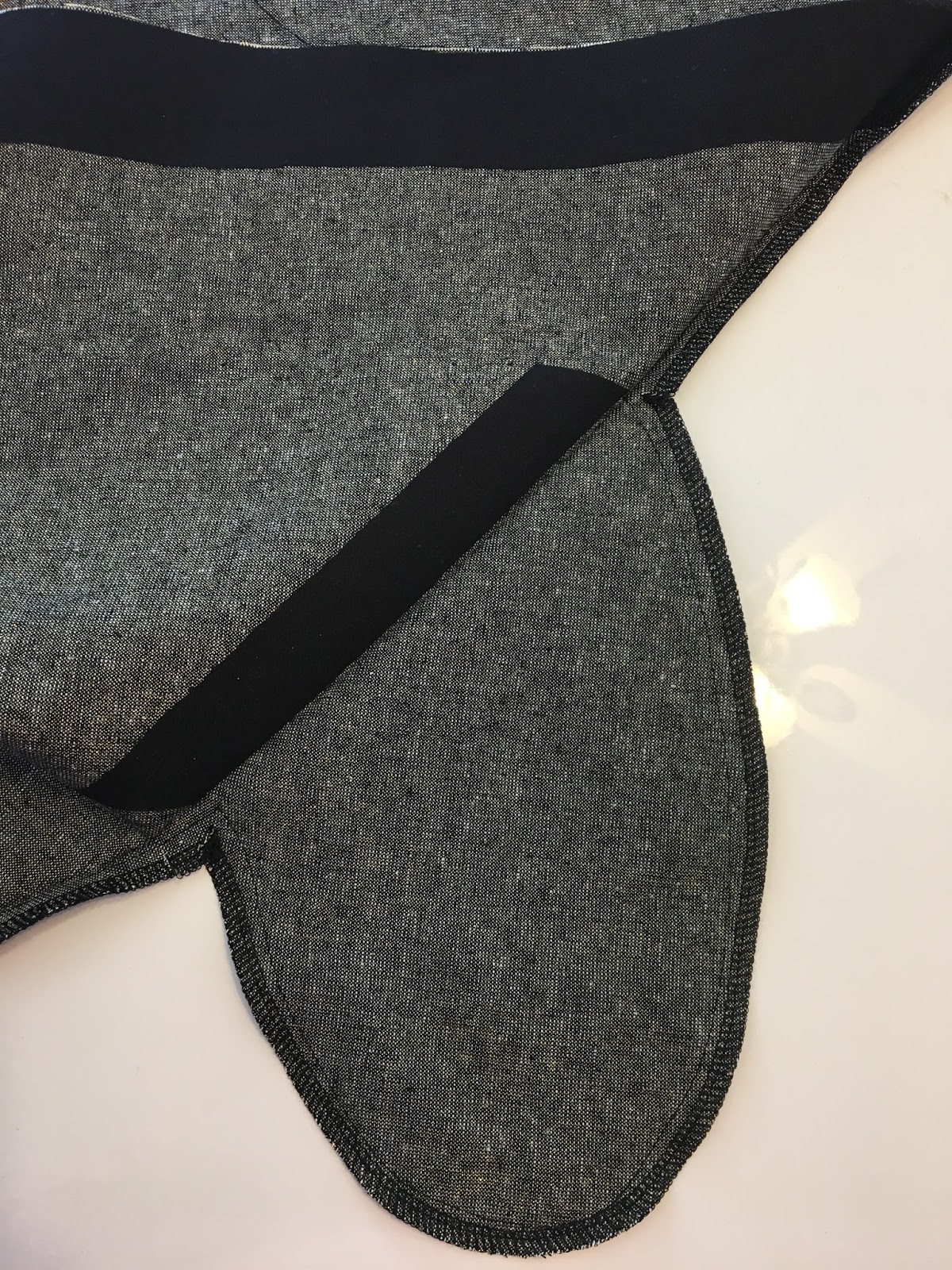

Great pockets which you can make larger if you like!

Another great tip for finishing curved seams is 1) clip the curves first, then 2) while serging the clipped curved, gently pull it straight, spreading the clipped seam and serge right through.  This allows the curved seam to be able to stretch.


The Sapporo is a fully lined coat as designed, but it can be made in an unstructured manner as well.  We finished off the sleeve hems by adding a bias tape...


Then turned and hemmed by hand for a neat, professional look.


You can see the detail of this lovely coat better from the inside!


Beautiful inside and out!
Ah those pockets are so dreamy!!!
The inside is so pretty on this unlined metallic linen version
Great look at back of the coat with its full drape!
Ah my dream jacket! What other fabric will I use?!
I love this nice stand up collar! If you choose a fabric with more body, you get this stunning look!
Thank you Laurel for letting us all try on your Sapporo Coat - 
we all fell in love with it!


As with most of life's opportunities, we can use garment making as a challenge, opportunity, and catalyst to create and evolve. 

Thank you for joining me in making clothes that matter!

SuZan
2518 Shattuck Ave. @ Dwight Way
South End, Downtown Berkeley

p.s. Please stop by and say hi to me in the store. I love to hear about what inspires you to make your own clothes!


The Sapporo Coat is from the Sakura Collection by Papercut Patterns 

Wednesday, September 27, 2017

Finding Community on the Internet - The Minttu Swing Top Tip!

Like many of our experienced home sewists who have been using patterns and following directions for years, we have learned different techniques, tricks, and shortcuts to accomplish the same result as what the pattern maker intended. But when we make a garment from one of our indie pattern makers for the first time, we always try to construct it according to the instructions included in the pattern. We want to understand the methods given from the designer to better help you construct your own version of a particular garment.


The Minttu Swing Top from Named Clothing's Playground Collection is a "simple and loose fitting A-Lined jersey top with round neck and slightly angular armholes."  It does look easy at first glance, and definitely cute. We chose this gorgeous cotton lycra knit print, available online or at Stonemountain & Daughter Fabrics in BerkeleyWe thought that the side panels could be cut on the bias to add a flattering detail to the top. 


So many great knits to choose from! Follow the link to check 'em out!


Putting on my new Minttu Top with my Flint Pants

The first steps of the instructions include attaching the side panels to the front and back sections of the top.  Easy enough.

The all in one facing is a great design feature for a sleeveless top such as the Minttu.  An all-in-one facing is sewn around the neckline and armholes, giving the garment a very polished look - no bias bindings to sew down or top stitching needed. Laurel, my seamstress, loves the all-in-one facings, but typically sews the neckline and armholes up to the shoulder seams, leaving them open to allow turning the facing, then sewing the shoulders carefully by hand.

The Minttu uses a different technique that was confusing to Laurel at first.  She read and reread the instructions a few times, but was having trouble deciphering exactly what they meant.


So what do you do in such a case? It took a while to find it, but on the Internet we found a You-Tube video explaining the application of the all-in-one facing on this exact Named top, the Minttu. Eureka!! This is what we love about the sewing community - sewing bloggers love to show their accomplishments and their projects, and many of them do tutorials. You have to love YouTube...so don't ever be afraid to do a search when you reach a stumbling block such as Laurel experienced.


After watching the video, sponsored by Indie Sew, we realized the instruction that was tripping Laurel up involved the "grabbing of the seam allowance and pulling the armhole wrong side out."  We discovered that it's all in how you reach up in between the bodice shell and the facing and do the "grabbing."


It really difficult to demonstrate in these still photos.  As they say in the studio, "you have to see the movie" to get it. But once we watched the video a couple of times, we wondered why we made it so hard. It isn't a challenging technique if you know what you're doing. And yes, you can teach an old dog (or sewist) new tricks!


The armholes are sewn in two steps...first the front is sewn using the "grab, pull and pin" technique, then the back of the armhole, following the same technique.  When the garment is turn right-side out, the result is a beautifully finished neckline and armhole.


We used a twin needle to hem the Minttu Top after adding a little fusible tape to cut down on the rolling that often happens with knits.


Such a polished finish on the neck and armholes...and no hand sewing.


Fabric on the bias for the side panels.
What a great detail!


Feeling good in my Minttu Swing Top with my new Safran Jeans!

We could totally make this top again - we love the flowing nature of it.  And once we got the technique of the all-in-one facing down, we aren't likely to forget it.  The beauty of it is that the shoulder seams are smooth and flat which is sometimes a problem using the open shoulder hand-sewn method.

Thank heavens that we have such a powerful resource in our community through the internet. Where would we be without our blogging and social media friends!  There is much to learn about sewing, and we like to think that we here at Fabriclady and Stonemountain Fabrics inspire you as well to try new techniques.  We are not too proud to learn from you and nor are we thinking we know it all.  Both Laurel and I have been creating garments for years, and we love to call ourselves life-long students of all that is creative and beautiful. We learn from you and you inspire us everyday.


Thank you for being a part of our story.

With love and many blessings,
Suzan


What fabric would you use for your Minttu Swing Top?


Monday, September 18, 2017

Striking a Chord - the Sointu Kimono Tee is a Harmonious Hit!


At Stonemountain & Daughter Fabrics, our Indie pattern designers are some of the most inspiring and talented designers we have come to love. It's one of the reasons why we made the switch from the Corporate/Big 4 pattern companies to these independent pattern companies. No matter what your sewing skills are, you can find designs to suit your abilities.  And we love giving these (mostly) women-owned businesses a leg up in this challenging, competitive industry.

One of our new pattern lines is Named, a Finnish clothing pattern label founded by sisters Saara and Laura Huhta. In their own words, "the story of Named started from the dream of turning a passion into a career, designing their own collection of clothing patterns felt like a natural way to implement both sisters’ love for clothes, fashion, design and DIY. The duo wants to encourage fellow fashion lovers to give sewing their own garments a try." Seems like our values and mission are so aligned!


Like so many of our Indie Patterns, Named patterns have a name (Check out my previous blog, "More than a number").  The "Sointu" is a kimono style loose fitting top.  Sointu means "chord" in Finnish. The notes in a chord can be harmonious (angelic) or dissident (nails on a chalkboard), but the Sointu is definitely a beautifully harmonious blend of ease, femininity, and versatility.


Though it's drafted for knits, we chose to make our Sointu in a woven cotton ikat, one of our go-to fabrics for all-weather wear. Ikats come in all weights, but our indigo blue is lightweight and the perfect fabric for late Summer into Fall. One of the beautiful things about ikats is the variation in the weave itself.  If you're looking for perfection in a woven fabric, you won't find it in an ikat.  But their imperfect perfection is what makes them so vibrant and appealing...besides their wearability and versatility.


The Sointu instructions call for bias binding around the neck area. If we were using a knit, bias bindings tend to be easier to apply around the curves of a neckline or armhole.  But since we are working with a woven, we chose to make a facing. Just trace the neckline on a piece of pattern paper and cut the width about 2-3 inches wide.  We always stock pattern paper in the store!

My sister from a different mother (and seamstress) Laurel had to try a Sointu as well. Her Sointu features a facing made of a scrap of musical chord fabric she had on hand.  Very appropriate, huh? You can see how the facing is applied around the neckline.


Don't forget to clip your curves and understitch your facing if you choose to go this route, rather than the bias tape.


My finished Sointu


We can see so many different ways to make this easy top. Perhaps we'll try it in a knit. Or turn it into a dress...and add some pockets and forget the belt. We just love it in this ikat fabric!!


Colette is ready for a garden party...
The Sointu's sizing is very generous, so decide how much ease you like in a top and choose your size accordingly.


Laurel's Cactus Sointu...


Preview of the Sapporo Coat!
No. 1 Pant with Button Detail!
Out for our lunch date in our Sointu Kimono Tees! We just love the
versatility and grace of these tops!
We appreciate the way certain musicians "play by ear," looking for the right combination of notes, chords, and tempo to make a song.  Sewing is like that...we roam the fabric aisles, looking for just the right fabric to go with the perfect pattern, adding the perfect trim and buttons and all coming together in a beautiful creation of our own making.  Sewing a beautiful garment is a labor of love and when we wear it, we feel the "music" of our creation.

We have enjoyed the "Summer of Love" Challenge...seeing your garments and feeling the love. Let's keep making beautiful music together this Fall!  Show us your indie pattern garments and where you wore them.  Did you make something special for a concert or a vacation or a night out on the town? We want to see it!


Stonemountain and You...Making beautiful music together.

With love, your FabricLady,
Suzan